
Euroanaesthesia 2026 Insights: XR Medical Simulation for Airway Management
Table of Contents
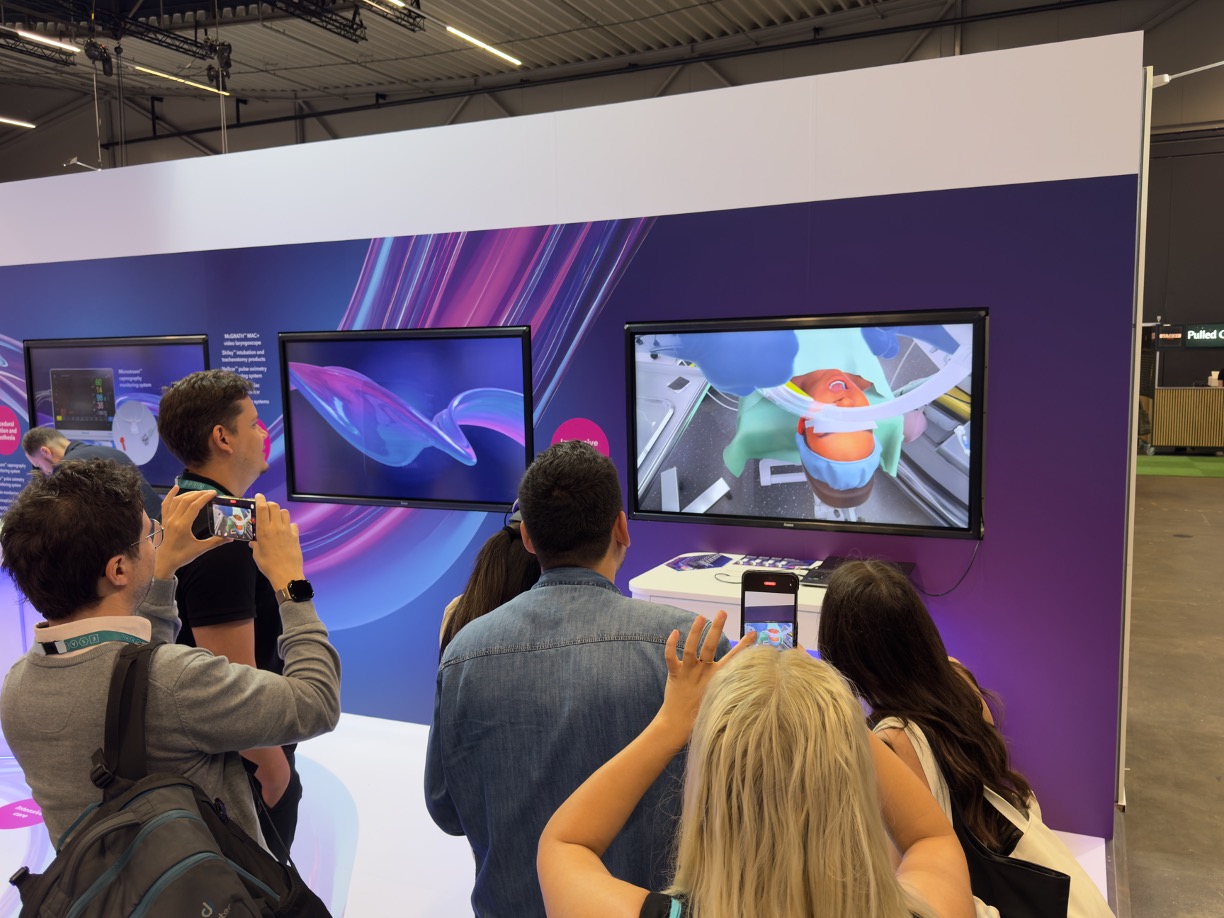
Euroanaesthesia 2026’s main insight is that the future of clinical education is built around readiness. At this year’s congress in Rotterdam, Lucid Reality Labs joined Medtronic to support the presentation of VR Intubation and Tracheostomy simulation experiences developed for clinical education and procedural training. The experiences allow clinicians to rehearse complex airway management procedures, including difficult intubation and tracheostomy, in realistic and repeatable virtual environments before facing those situations with real patients.
Among the most important highlights of the event was that subject matter experts, practicing clinicians, educators, and healthcare leaders, interested in simulation-based education, were actively discussing how it can become more scalable, measurable, and directly connected to patient safety. That signals clear market demand and a growing understanding that technology in clinical education must go beyond individual experiences. It needs to provide a systemic approach and infrastructure: repeatable training environments, consistent learning pathways, performance insights, and scalable deployment across teams and locations.
For Lucid Reality Labs, Euroanaesthesia 2026 reinforced a broader direction for healthcare training: medical simulation is in irreversible transition from standalone technology demonstrations toward enterprise-ready clinical training infrastructure, driven by both simulation and Artificial Intelligence.
Euroanaesthesia 2026: Why it Matters for Medical Simulation
Euroanaesthesia is one of the most important annual congresses for anaesthesiology and intensive care, organized by the European Society of Anaesthesiology and Intensive Care (ESAIC). It brings together clinicians, researchers, educators, healthcare leaders, and medical technology companies to discuss the future of patient care, clinical practice, and innovation.
This made the congress a highly relevant environment for conversations around XR medical simulation. Anaesthesiology and critical care are fields where readiness, precision, and decision-making under pressure are essential. Training for complex procedures cannot rely only on theory or occasional exposure to real-life cases. Clinicians need safe, repeatable ways to practise high-risk scenarios and build confidence before those situations occur in patient care.
At Euroanaesthesia 2026, simulation-based education was a visible part of this conversation. The event programme included themes related to VR in medical education, procedural techniques, airway planning, and airway management. This context strongly aligns with the work Lucid Reality Labs is doing in healthcare XR: building immersive training systems that help organizations prepare teams for complex clinical workflows.
Airway Management as a Critical Use Case for XR Simulation at Euroanaesthesia
Airway management is a strong example of where immersive simulation can create practical value.
Difficult intubation and tracheostomy are complex procedures that require technical skill, clinical judgement, sequencing, and the ability to act under pressure. In real clinical settings, these situations can be high-risk and time-sensitive. That makes controlled practice especially important.
VR simulation gives clinicians the ability to rehearse these procedures in a safe environment where they can repeat scenarios, practice different levels of difficulty, and build familiarity with critical steps. It also allows training to become more consistent across teams and locations, which is essential for healthcare organizations looking to standardize clinical education.
The VR Intubation and Tracheostomy experiences developed by Lucid Reality Labs for Medtronic are built around this need: realistic, repeatable procedural training that supports clinical education and procedural readiness.
What Clinicians’ Reactions Revealed at Euroanaesthesia
One of the most valuable parts of Euroanaesthesia 2026 was observing how subject matter experts and practicing clinicians interacted with the simulations. Their responses validated three essential foundations of scalable medical simulation: realism, immersion, and usability.
1. Realism supports clinical credibility
Participants highlighted the visual fidelity and procedural detail of the experiences. The tracheostomy sequence, in particular, received strong attention because of the level of detail in the procedural flow.
This matters because medical simulation cannot be effective if users do not trust the environment. For clinicians, realism goes beyond impressive graphics, enabling the simulation to reflect the clinical context closely enough to support meaningful practice.
High visual and procedural fidelity helps users focus on the task, understand the sequence of actions, and engage with the scenario as a serious training environment rather than a generic VR experience.
2. Immersion supports focus and presence
Some participants became so immersed that, after completing the simulation, they instinctively tried to place their physical controllers on the virtual table.
This moment was small, but strategically important. It showed that the virtual operating room felt believable enough for users to carry their behavior from the simulated environment into the real one.
For clinical training, this level of presence can be valuable because it helps users engage with the environment more naturally. When the simulation feels credible, learners can focus less on the technology and more on the procedure, decision-making, and workflow.
3. Usability supports adoption
Most users were able to navigate scenarios at different difficulty levels with minimal guidance.
This is a key requirement for enterprise adoption. Advanced simulation technology only creates value when healthcare professionals can use it confidently and efficiently. If a system requires too much onboarding, constant facilitation, or technical explanation, it becomes harder to scale.
An intuitive user experience supports broader deployment across organizations. It helps reduce training friction, makes repeated use more practical, and allows clinicians to focus on learning rather than on operating the system.
From VR Demonstration to Clinical Training Infrastructure
The feedback from Euroanaesthesia 2026 reflects a larger shift in clinical education. Healthcare training is transforming from isolated technology demonstrations to scalable training infrastructure, and from procedural instruction alone to overall better preparation for high-risk situations.
For medical simulation to support this shift, it needs to do more than recreate a procedure in VR. It must combine several capabilities:
- clinical realism
- intuitive interaction
- repeatable workflows
- adjustable difficulty levels
- measurable performance insights
- scalable deployment across teams and locations
- alignment with patient safety and procedural readiness
This is where simulations, often empowered by Artificial Intelligence, can create a stronger foundation for the next generation of healthcare training.
The opportunity is to build AI-powered clinical training systems that can help organizations standardize education, adapt learning to different levels of experience, track performance, and support continuous readiness. See the world’s 1st medical AI-Powered XR intubation simulation for more details.
The Østergaard Declaration Signals a Turning Point for Simulation-Based Education
One of the most significant announcements at Euroanaesthesia 2026 was the launch of the Østergaard Declaration by ESAIC.
The declaration represents a European call to action for simulation-based education and training, placing patient safety at its core. Rather than viewing simulation as an optional educational tool, the declaration argues that simulation should be recognized as essential healthcare and educational infrastructure that supports workforce competence, team performance, organizational resilience, and safer patient care.
This perspective closely aligns with the direction healthcare training is already taking. Decades of evidence have already established simulation’s value. The challenge now is implementation, accessibility, standardization, and sustainable deployment across healthcare systems.
For organizations investing in XR medical simulation, this shift is significant. It reinforces the idea that immersive training is evolving beyond isolated educational experiences toward a broader role in clinical readiness, workforce development, and patient safety.
The Role of AI-Powered XR in the Future of Clinical Education
AI-powered XR has the potential to transform how healthcare organizations approach training. Instead of relying only on one-time workshops or static learning materials, organizations move toward interactive training environments where clinicians can practice complex workflows, receive structured feedback, and improve performance over time.
For healthcare and medical device companies, this can support more consistent education across geographies, teams, and user groups. For clinicians, it can provide more opportunities to rehearse rare or high-risk situations. For educators, it can create better visibility into learner progress and training outcomes.
The future of medical simulation is enterprise-ready, AI-driven training infrastructure: systems that combine clinical realism, intuitive interaction, measurable performance, and scalable deployment while keeping clinicians and educators in control.
That direction was strongly reinforced by the conversations and participant feedback at Euroanaesthesia 2026.
About Lucid Reality Labs
Lucid Reality Labs is an award-winning AI-powered XR software development company, creating next-generation immersive training, simulation, and enterprise solutions for global leaders in healthcare, manufacturing, and MedTech. Founded in 2016, the company partners with organizations such as Medtronic, the American Red Cross, and Universal Destinations & Experiences to design transformative tools that advance learning, safety, and performance through cutting-edge extended reality and AI technology.
Through collaborations with leading technology companies and global innovators, Lucid Reality Labs continues to advance immersive technologies that strengthen performance, safety, and innovation in enterprise environments.